-
-
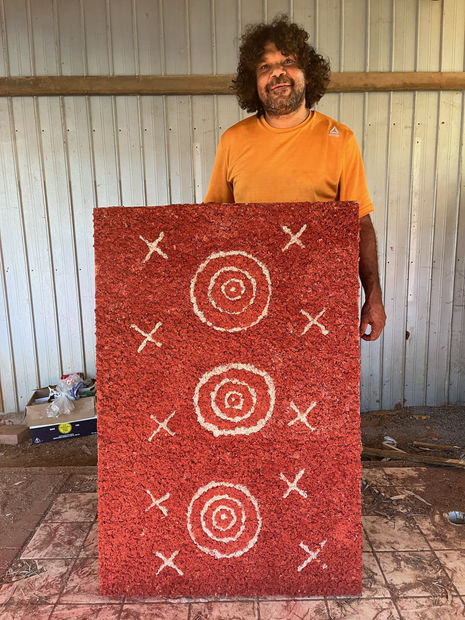
Martin Hagan’s work is born from the ceremonial ground.
Martin is from Laramba, a community excision within Napperby Station - cattle country that is between the well-known art-producing communities at Papunya and Yuendumu. Several of the key founders of Papunya Tula art, including Kaapa Tjampitjinpa, Clifford Possum, Tim Leura and Billy Stockman, grew into manhood at Laramba in the 1930s and worked as stockmen on the station. Despite the fame of the first generation of contemporary Anmatyerr artists, the Laramba community has never had its own art centre. In this absence, Clifford Possum, returning to visit family as a celebrated artist in the 1980sand 90s, became the single, most important influence on the Laramba artists.
Having grown up around senior Anmatyerr men and women, Martin has developed a genuine passion for the cultural knowledge of his elders. His work conveys a deep commitment to Anmatyerr cultural traditions, particularly ceremonial design and performance, and a desire to see its distinctiveness recognised. The centrality of ceremony to Martin’s labours is evident in his choice of materials. Each board is comprised of chopped common everlasting daisy, known as anteth anpay-anpay in Anmatyerr: a reasonably abundant plant species featuring yellow flowers and grey-green foliage that is regularly used to decorate ceremonial bodies and objects. After being harvested en masse, chopped with an axe and combined with natural pigments, anpay-anpay is transformed into a material that can be affixed to a range of surfaces. Martin’s use of this material, sculpted to render bold ritual iconography, deliberately invites us to imagine the aesthetics of Anmatyerr ceremony.
Martin’s anpay-anpay boards, while uniquely his own and a testament to his creative energies, are also an extension of this cultural maintenance and preservation work. Embedded in each board are unseen layers of intangible cultural knowledge. Most of the boards have associated songs and ceremonies that are performed for them. He follows a time-honoured trajectory - starting from ceremony and then, building on the knowledge he attains in ritual, he conceives and creates new art.
Growing up with the legacy of his grandfather, Clifford Possum, Martin Hagan is cognisant of Laramba’s artistic history. His practice is inspired by the spirit of innovation that led Possum and other Larambamen (Tim Leura and Kaapa Mpetyan/Tjampitjinpa) to develop the desert art movement at Papunya in the early 1970s. Following in their footsteps, Martin draws from the well of ceremonial tradition without being bound by it. As John Kean has noted “Martin is now at the same age as Clifford Possum when I knew him. His works recall the power of the paintings that Possum created during the mid 1980s, a short phase when the master technician’s compositions were created entirely with dots (see for example Clifford Possum, Mulga Seed Tjukurrpa 1983 Araluen Arts Centre). Martin employs a very similar gesture to create fields of culturally weighty colour. Just as Possum’s brush was loaded with acrylic paint of specific viscosity to create the dot, Martin’s heavily textured fields are created incrementally, the accumulation of numerous pinches of anteth anpay-anpay applied to the surface of a board to build figure and ground. Martin’s repeated gesture connects time and space, linking his current moment with the achievements of his ancestors.”
Like the men who came before him, Martin nurtures local religious and cultural knowledges, not only through the continuation of ceremonial Law but with a careful crafting of new intercultural forms of expression and creative inquiry. Just as the early painters travelled the globe to share their art, Martin and the men of Laramba have also recently contributed ground paintings for the Nothing is Too Beautiful for the Gods exhibition, curated by Jean-Hubert Martin at Fondation Opale, Switzerland.
In this exhibition Martin permits us a window into a cherished yet vulnerable ceremonial life. This is deeply personal for Martin. “I get emotional sometimes when I listen to the old people singing. They always say, ‘You mob gotta carry on now.’” This is a generous body of work that conveys one man’s sense of obligation to, and love for, his cultural inheritance.
Text taken from both John Kean & Jason M. Gibson’s catalogue essays.
-
Installation
-
-
 Martin Mbitjana HaganPossum Dreaming, 2025Wamulu, Pigment & Binder On Board101 x 75 cmSold
 -
Martin Mbitjana HaganKwatye Soakage, 2025Wamulu, Pigment & Binder On Board101 x 75 cmSold
-
Martin Mbitjana HaganFish Trap - Ntjonba, 2025Wamulu, Pigment & Binder On Board101 x 75 cmSold
-
Martin Mbitjana HaganBudgeri Bird Creation Story, 2025Wamulu, Pigment & Binder On Board85 x 43 cmSold
-
Martin Mbitjana HaganBudgeri Bird Creation Story, 2025Wamulu, Pigment & Binder On Board70 x 50 cmSold
-
Martin Mbitjana HaganKngarlu Love Story, 2025Wamulu, Pigment & Binder On Board70 x 50 cmSold
-
Martin Mbitjana HaganPossum Hunting, 2025Wamulu, Pigment & Binder On Board70 x 50 cmSold
-
Martin Mbitjana HaganCorkwood Tree Story, 2025Wamulu, Pigment & Binder On Board70 x 50 cmSold
-
Martin Mbitjana HaganEmu Hunting, 2025Wamulu, Pigment & Binder On Board70 x 50 cmSold
-
Martin Mbitjana HaganKangaroo's Worms, 2025Wamulu, Pigment & Binder On Board70 x 50 cm$ 1,250.00
-
Martin Mbitjana HaganKangaroo's Worms, 2025Wamulu, Pigment & Binder On Board70 x 50 cmSold
-
Martin Mbitjana HaganBrother's Conflict, 2025Wamulu, Pigment & Binder On Board70 x 50 cmSold
-
-
Artists